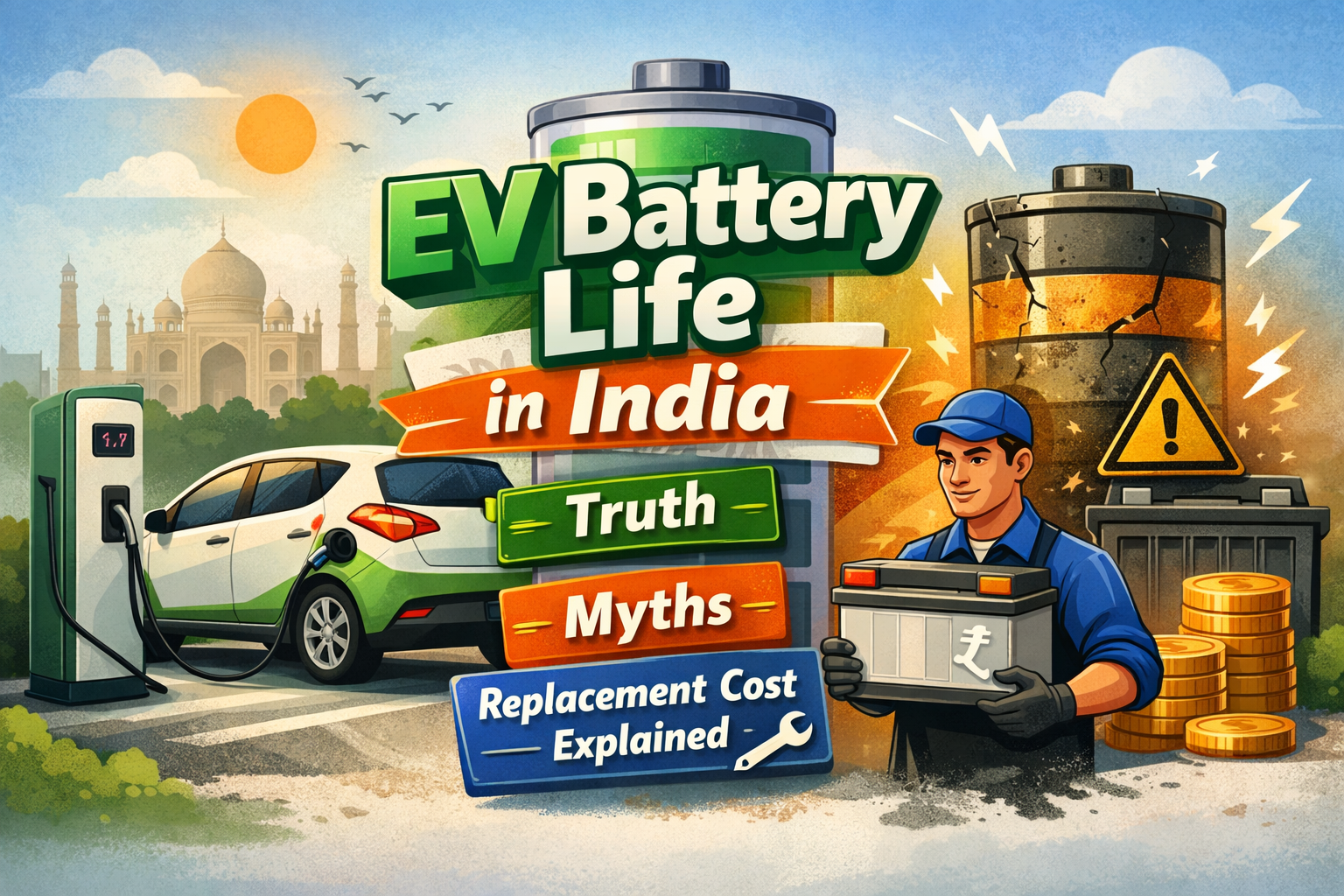
Battery life remains one of the most discussed topics when it comes to electric vehicles in India. For many potential buyers, the battery feels like a mystery component — unfamiliar, technical, and possibly expensive to replace. Questions such as “Will it fail in five years?” or “Will I have to spend lakhs on replacement?” are common. These concerns are understandable. For decades, Indian vehicle owners have been familiar with internal combustion engines. Engines have predictable service cycles, repair practices, and long-term ownership data. In contrast, EV battery technology feels new. However, modern EV batteries are far more durable and reliable than common myths suggest. To understand EV battery life in India realistically, we need to look at battery technology, degradation patterns, warranty coverage, replacement costs, and Indian climate conditions. What Type of Batteries Do EVs Use in India? Most electric vehicles in India today use advanced lithium-ion battery technology. Lithium-ion batteries are widely used globally in: Electric cars Electric scooters Smartphones Laptops Energy storage systems They are chosen for EVs because they offer: High energy density Long cycle life Stable performance Relatively low maintenance These are not the same as small consumer batteries. EV battery packs are engineered with sophisticated control systems and safety mechanisms. How Long Do EV Batteries Last in India? Modern electric vehicle batteries are typically designed to last: 8 to 10 years under normal usage conditions OR 1.5 to 2 lakh kilometres depending on driving patterns Most manufacturers in India offer warranties of: 8 years Up to 1.6 lakh kilometres These warranties generally guarantee that the battery will retain a certain percentage (often around 70%) of its original capacity during the covered period. This is an important point: EV batteries do not suddenly stop working. Instead, they gradually experience minor capacity reduction over several years. Understanding Battery Degradation Battery degradation is a gradual process. Over time, lithium-ion batteries lose small amounts of capacity. This means: A 400 km range car may become a 360–380 km range car after several years Performance reduces slowly, not abruptly The vehicle remains usable for daily commuting In many global studies and real-world ownership data, EV batteries retain: More than 80% of their original capacity even after 5 years of use. For city commuters in India who drive 30–50 km daily, this level of performance remains more than sufficient. How Does Indian Weather Affect EV Battery Life? India’s climate raises legitimate concerns — especially extreme summers where temperatures can cross 45°C in certain regions. Modern EVs address this through: Thermal management systems Liquid cooling or air cooling mechanisms Battery management systems (BMS) These systems regulate temperature and protect the battery from overheating during high ambient temperatures. While extreme heat can influence battery performance slightly, manufacturers design EVs specifically for Indian climate conditions. Extensive testing is conducted in high-temperature environments before market release. As a result, battery life in Indian conditions is far more stable than many assume. What Affects EV Battery Lifespan? Several factors influence battery health over time: Driving habits Frequent fast charging Extreme temperature exposure Charging to 100% constantly Deep discharging regularly However, battery management systems automatically protect against excessive stress in most modern EVs. For average urban users who charge overnight and drive moderate distances, battery wear remains slow and manageable. How Much Does EV Battery Replacement Cost in India? Battery replacement cost is one of the biggest fears among potential buyers. Currently, EV battery replacement costs in India can range between: ₹3 lakh to ₹6 lakh for electric cars (depending on battery size) However, two key realities must be understood: Most users will not need battery replacement within the first 8 years due to warranty coverage. Battery prices have been steadily declining globally due to scaling production and technological advancement. Global battery pack prices have dropped significantly over the past decade (BloombergNEF data trends), and this trend is expected to continue. By the time replacement becomes necessary for most users, costs are likely to be lower than current estimates. Is Battery Replacement Common in 5–7 Years? For most users who plan to own their vehicle for five to seven years, battery replacement is unlikely to become a financial burden. Real-world ownership data globally suggests: Gradual degradation Very low early-failure rates Strong warranty backing The fear of early battery failure largely stems from outdated information or early-generation EV technology. Modern EV battery packs are engineered for longevity and durability. EV Battery Recycling in India Another important long-term consideration is battery recycling. Used EV batteries often retain 60–70% of their original capacity even after automotive use. These batteries can be repurposed for: Stationary energy storage Solar backup systems Industrial energy management India is gradually building infrastructure for battery recycling and second-life applications. Government policies are increasingly supporting circular battery economies. This reduces environmental impact and improves overall lifecycle efficiency. Battery recycling advancements also help stabilize long-term replacement costs. Myth vs Reality: EV Battery Life in India Myth: EV batteries fail within 3–4 years. Reality: Most are designed for 8–10 years and backed by warranty. Myth: Replacement is inevitable during normal ownership. Reality: Most users do not require replacement within 5–7 years. Myth: Indian heat destroys EV batteries quickly. Reality: Thermal management systems protect battery health effectively. Myth: Battery degradation makes EV unusable. Reality: Even at 80% capacity, daily commuting needs are easily met. Quick Answers (Featured Snippet Optimized) How long do EV batteries last in India? Typically 8–10 years or up to 1.6 lakh kilometres under normal usage. Do EV batteries suddenly fail? No. They degrade gradually over time. Is EV battery replacement very expensive? It can be costly today, but warranties cover most early ownership periods, and prices are declining. Does Indian heat damage EV batteries? Modern EVs include thermal management systems designed for Indian climate conditions. Should Battery Life Stop You from Buying an EV? For most urban Indian users, battery concerns are often exaggerated. If you plan to: Drive 800–1,200 km per month Own the vehicle for 5–7 years Charge primarily at home Battery life is unlikely to become a major financial or operational issue. In fact, warranty coverage provides significant peace of mind. Understanding modern battery engineering helps buyers move beyond myths and make informed decisions. Final Verdict EV battery life in India is more reliable than public perception suggests. Modern lithium-ion batteries are engineered for long-term durability, gradual degradation, and real-world climate conditions. With 8-year warranties, advanced thermal management systems, declining battery prices, and improving recycling infrastructure, the long-term risk associated with EV batteries is steadily decreasing. For most buyers, battery replacement is not a short-term concern — and fear of early failure should not overshadow the long-term financial and environmental benefits of electric mobility. If you’re exploring electric vehicles, read our complete EV ownership cost guides to understand charging, maintenance, and long-term savings in detail before making your decision. Data References Manufacturer Warranty Disclosures (India, 2026) BloombergNEF Battery Price Trend Reports Ministry of Heavy Industries – EV Policy Data Public Domain EV Longevity Studies Disclaimer Battery lifespan varies based on driving habits, charging behavior, environmental exposure, and vehicle model. The figures mentioned are average estimates based on publicly available data and are intended for informational purposes only.